
Article: Black Tie vs White Tie: What the Difference Actually Means

Black Tie vs White Tie: What the Difference Actually Means
You've received the invitation. Somewhere near the bottom, in careful typography, it says Black Tie — or perhaps White Tie. Two dress codes. One of them is the most formal thing you will ever be asked to wear. The other is the most common formal dress code in the world. They are not interchangeable, and arriving in the wrong one is one of the most visible mistakes a man can make.
Here's what each requires, why the distinction matters, and exactly how to get it right.
Black Tie: The Standard of Formal Evenings
Black tie is the dress code of elegant evening weddings, galas, award dinners, and private celebrations where the host intends the occasion to feel like an occasion. The rules are well-established — and for good reason. Every element exists to create a unified, elevated aesthetic.
The jacket. A black or midnight blue dinner jacket — the tuxedo — in single or double-breasted. Lapels in satin or grosgrain. No flap pockets.
The trousers. Matching, with a single silk braid down the outer seam. No cuffs.
The shirt. White, always. Pleated or plain bib front. French cuffs. A stiff collar or soft turndown — both are correct.
The shoes. Black patent leather Oxford or opera pump. Polished to a mirror finish.
The bow tie. Black silk, self-tied. This is non-negotiable.
The bow tie is where black tie gets its name, and where most men make their first mistake. A pre-tied bow tie — regardless of how well it sits — is considered a shortcut. The slight imperfection of a hand-tied knot is not a flaw. It is the mark of someone who knows how to dress. Our Jet Black Solid Silk Bow Tie is the definitive choice here: pure Italian silk, correctly proportioned, with the weight and sheen that separates it from anything you've worn before. Every wardrobe needs this piece. It is the anchor.
White Tie: The Highest Formal Dress Code in Existence
White tie is reserved for the grandest occasions — state dinners, royal events, opera galas, and the most ceremonially significant weddings. Where black tie allows the event to feel elegant, white tie demands that it feel historic. The requirements are absolute.
The jacket. A black evening tailcoat with silk-faced peaked lapels. Cut short at the front, long at the back.
The trousers. High-waisted, with two silk braids down the outer seams. No cuffs.
The waistcoat. White piqué. Low cut, backless, worn over a white piqué dress shirt with a stiff bib front and wing collar.
The shoes. Black patent leather Oxford or opera pump — identical to black tie.
The bow tie. White piqué, self-tied. No exceptions. The bow tie matches the waistcoat fabric. This is where the dress code takes its name.
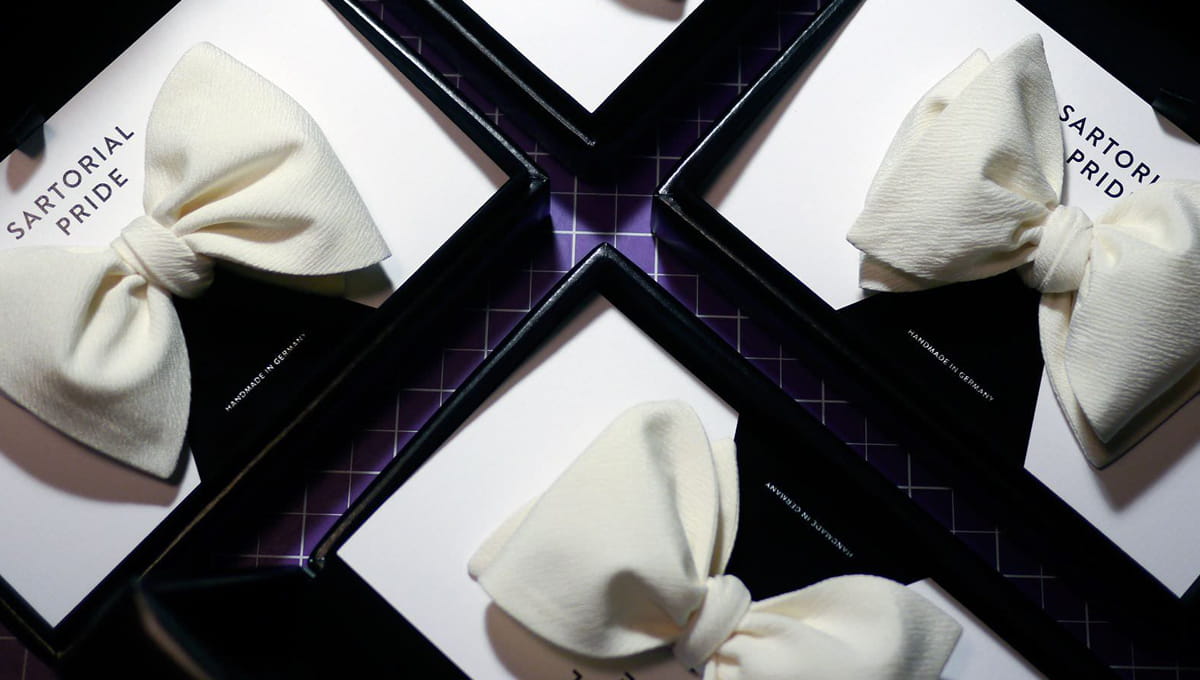
A note on fabric: strict white tie traditionally calls for piqué — a textured cotton weave — rather than silk. If you want the white tie aesthetic with a silk finish, our Ivory White Solid Silk Bow Tie is the closest silk equivalent: pure Italian silk in luminous ivory, with a hand that moves the way candlelight does. For strict white tie protocol, a piqué bow tie is the correct choice. For a formal wedding where white tie is the dress code but the atmosphere is more intimate than ceremonial, the silk ivory is entirely appropriate.
The Difference at a Glance
| Black Tie | White Tie | |
|---|---|---|
| Jacket | Dinner jacket (tuxedo) | Tailcoat |
| Trousers | One silk braid | Two silk braids |
| Shirt | Pleated or plain, turndown collar | Stiff piqué bib, wing collar |
| Waistcoat | Optional | White piqué, required |
| Bow tie | Black silk | White piqué |
| Formality | Formal | The most formal |
Is There Room to Personalise Black Tie?
Within black tie, there is limited but real room for individual expression. The bow tie must remain black — that is not negotiable — but the fabric and finish can vary. A silk satin bow tie has a different presence from a matte silk. The lapel style (peak versus shawl), the shirt front (pleated versus plain), and the pocket square (white linen, flat fold) all offer subtle points of distinction.
Where personalisation becomes visible is when you move from a strict black tie context into a black tie optional one. A wedding where the invitation reads Black Tie Optional allows for a dark navy or charcoal suit, and for a bow tie that introduces character without abandoning formality. Our Navy Blue Floral Silk Bow Tie belongs precisely here — deep navy Italian silk alive with scarlet blooms and exotic birds, rich enough to hold its own at a formal table, distinct enough to be remembered.
At white tie, there is no personalisation. Every element is prescribed. The distinction between a well-dressed man and an impeccably dressed one, at white tie, is the quality of what he wears — not the choice of it.
Groomsmen at Formal Weddings
At a black tie wedding, all groomsmen wear matching black silk bow ties. If the groom wants to distinguish himself from his party, a slightly different fabric or finish achieves this without breaking the dress code — a richer weave, a more pronounced sheen. The colour stays black.
At a white tie wedding, the groomsmen wear white piqué bow ties. There is no variation. The groom distinguishes himself through the tailoring and quality of his tailcoat, not the accessories.
The Self-Tie Rule
The asymmetry of a hand-tied bow — the slight unevenness that no machine can replicate — is what tells a room that the man wearing it knows exactly what he's doing. At black tie and white tie both, a clip-on or pre-tied bow tie is considered a shortcut. The knot matters.
What most guides don't tell you is what happens later in the evening.
There is a specific moment at every great wedding — jacket off, top button undone, bow tie hanging loose around the neck, both ends falling open. It is one of the most recognisable images in men's style. It signals a man who has been fully present, fully celebrating. It looks effortless because it is effortless — and it is only possible with a genuine self-tied bow tie. Pull one end and it opens cleanly. Both sides hang loose around the collar. The knot is gone, and what remains is exactly right.
A standard pre-tied bow tie cannot do this. Most have a knot that is either faked entirely or stitched shut to hold its shape — which means when you pull one end, nothing happens. Or it comes apart awkwardly, hanging fixed and stiff on one side of the collar, looking exactly like what it is. The knot was never real to begin with.
A note on how our bow ties are delivered. In twelve years of working with grooms, we have learned one thing with certainty: the morning of a wedding is not the moment to be practising bow tie knots for the first time. Every bow tie we send leaves us already tied — by hand, by us — and secured with a hook closure so you can put it on without touching the knot. What arrives at your door is a genuine hand-tied bow, with all the natural asymmetry that makes it look right. The hook simply means that knot was tied by someone who has done it thousands of times rather than once, under pressure, in a hotel bathroom mirror.
Later in the evening, when the moment comes, pull one end. It opens exactly as a self-tied bow tie should. Both ends hang loose. The knot is gone. The look is perfect.
If you want to tie it entirely yourself from scratch, we will arrange that — just ask. But most men, when they understand what the alternative actually delivers, are glad the decision was made for them.
The right bow tie for every formal occasion is in our collection. Explore out bow ties here.